AI can help a trader organise information, compare market scenarios and challenge an incomplete trading plan. It cannot reliably tell you where GBP/USD or EUR/USD will close tomorrow simply because you type “predict the market” into a chatbot. The difference matters: an organised research assistant can be useful, while treating a fluent prediction as a trading signal can create false confidence and larger losses.
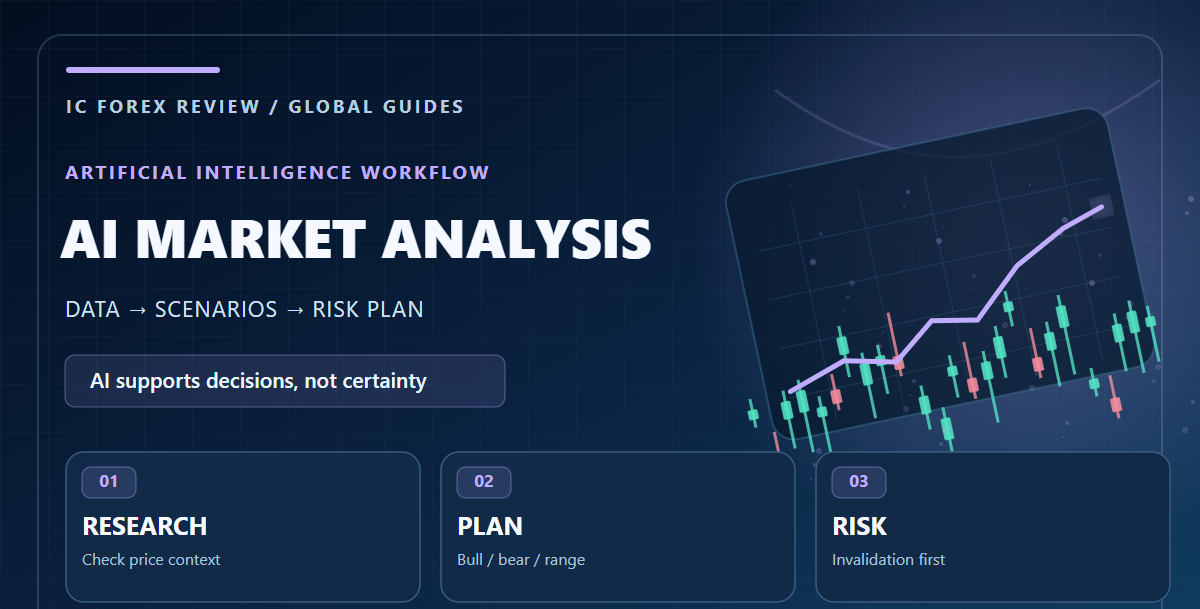
This guide shows a practical workflow for using AI alongside a normal charting platform, including MT4, MT5, cTrader or TradingView connected to an eligible IC account. It does not claim a broker partnership with an AI provider or suggest that the broker itself guarantees an AI-driven edge. The examples are educational and refer to general market analysis rather than live prices.
What AI is good at—and what it cannot know
Large language models are useful for summarising information, comparing competing explanations, translating complex economic reports into plain language and drafting testable hypotheses. They can also assist with spreadsheet formulas, Python scripts and checklists. Those are workflow advantages, not evidence that a model can see tomorrow's market or execute a strategy profitably.
AI output may contain fabricated numbers, inaccurate dates or made-up source references. A chatbot may also lack access to the current economic calendar, actual spreads or price feed. Never let a model invent a market quote and then size a trade from it. Gather market data from a verified source yourself and distinguish it clearly from the model's interpretation.
A five-stage research workflow for forex traders
| Stage | What the trader supplies | Useful AI task | What must be checked independently |
|---|---|---|---|
| 1. Market context | Pair, session, timestamp and recent prices | Summarise trend, range and volatility hypotheses | Actual chart and price source |
| 2. Economic drivers | Relevant calendar and central-bank statements | Compare plausible interpretations | Release time, figures and official statements |
| 3. Scenarios | Support/resistance and invalidation levels | Organise bullish, bearish and neutral cases | Price levels and whether the premise still holds |
| 4. Risk plan | Equity, permitted risk and stop distance | Calculate illustrative position size and R:R | Contract specifications and broker margin |
| 5. Review | Trading journal with outcomes and costs | Identify recurring process errors | Actual fills, spreads, commissions and bias |
At every stage the human trader remains responsible for verifying information and deciding whether the trade is appropriate. AI should make assumptions more visible, not hide them under a confident-sounding answer.
Start with real data rather than asking for a prediction
A useful analysis prompt begins with context: “I am reviewing GBP/USD on the H1 and M15 charts at [time and time zone]. Here are the recent swing highs/lows, ATR estimate and the next economic events. Identify three scenarios and their invalidation conditions. Do not invent missing prices, probabilities or news.” You can paste selected non-sensitive observations rather than account credentials or entire private trading statements.
This framing encourages the model to separate facts from assumptions. If it says price has broken resistance when your chart shows no completed candle above the level, the model is wrong. If it quotes a central-bank statement, verify it against an official announcement. AI-generated probabilities should not be treated as calibrated forecasts unless supported by appropriate out-of-sample testing.
Build three scenarios instead of one target price
For a major forex pair, plan a bullish scenario in which a defined resistance break holds; a bearish scenario in which a support level fails; and a range scenario in which neither breakout is confirmed. Each case needs an observation that would invalidate it. This is more useful than asking the model to print “buy now” without a defined reason.
Illustrative, entirely fictional example: price is consolidating between 1.2600 and 1.2700. Above a confirmed 1.2700 break, a trader might investigate continuation; below 1.2600, the alternative might be weakness; between the levels, the best decision may be to avoid a directional trade. These numbers are hypothetical teaching inputs, not current GBP/USD prices or recommended orders.
Use AI to challenge the trade, not just justify it
Before entering an order, ask the model what evidence contradicts your idea. Is the supposed breakout actually happening in low liquidity? Is a high-impact data release about to occur? Does the projected reward assume a fill that would be unrealistic during volatility? Could the position overlap risk already held in another correlated currency pair?
A useful AI output separates “supporting evidence”, “contradictory evidence” and “unknowns”. If the trade depends on too many unverified assumptions, passing on it can be more rational than seeking yet another model-generated confirmation.
Position sizing belongs to arithmetic, not persuasion
Suppose a trader has a hypothetical USD 2,000 account and chooses a 0.5% maximum planned risk per trade. The nominal risk budget is USD 10. If the stop distance is 20 pips on EUR/USD and the pip value for a standard lot is approximately USD 10, an elementary calculation suggests 0.05 lot before allowing for slippage and any other costs. The example is not a recommendation to trade that quantity.
Always verify the contract size, tick value, minimum lot, lot step and margin requirements shown for the actual IC symbol and account. Leverage limits may be tiered and can change around news. Never ask a chatbot to infer the live broker contract specification from an old screenshot or the name of a currency pair alone.
Where IC platforms fit into an AI workflow
AI can generate research notes independently of the trading terminal. MT4 or MT5 can then display the chart and execute trades through the broker, if the account is authorised and properly connected. cTrader provides a different trading environment, while TradingView offers extensive charting and alerts for compatible setups. Their automation languages, order APIs and risk characteristics are not interchangeable.
An AI-written Expert Advisor is still software that needs inspection and testing. It can contain programming errors, dangerous lot-size logic or faulty assumptions about trading hours and market orders. MetaTrader EAs and cTrader algorithms should be evaluated in an isolated demo environment before a trader even considers live operation.
Privacy and information quality
Do not paste broker passwords, personal identification documents, payment card information or private account access tokens into public AI services. A model normally does not need those details to explain a trading concept. If analysing a trade journal, remove names, account identifiers and other sensitive records. Review the AI provider's own data policy before uploading information.
Also mark timestamps and time zones clearly. A calendar event shown in New York time may occur on a different date in Asia; a model that mixes them can create a misleading pre-news trading plan. Treat unverified data as missing, not as a prompt to fill blanks with invented numbers.
A simple daily AI-assisted review routine
- Check the actual trading calendar and price chart from a trustworthy current source.
- Write your market context in a few neutral sentences without a predetermined prediction.
- Ask AI to organise possible scenarios, their supporting evidence and invalidation levels.
- Verify every quoted number and event against primary sources.
- Calculate position risk independently and check your broker's margin and spread conditions.
- Trade only if the plan meets your own rules; choosing no trade is acceptable.
- Record actual fills, costs and what happened, then use AI to identify repeated decision errors.
Why AI does not guarantee profit at IC Markets
Profitable trading would require a durable statistical edge after spreads, commissions, slippage, financing and the impact of changing market regimes. A persuasive explanation from a language model is not such evidence. Neither fast execution nor a Raw Spread account converts a weak forecast into a profitable method. The IC broker review covers published trading-account conditions; our Risk Disclosure explains why leverage can produce substantial losses.
Sources, limitations and disclosure
This is an independent educational workflow. For platform support and account availability, refer to IC's official platforms page, trading conditions, and the applicable broker legal documents. No live market data, independently verified AI model or backtest results are claimed in this article.
IC Forex Review may receive compensation from qualifying readers using an IC partner link. That commercial relationship is not proof of AI performance or a recommendation to risk capital. See the Editorial Methodology.

Comments
Post a Comment