A demo account is an excellent place to learn how to enter orders, inspect margin and test the mechanics of a trading plan. It is not a certificate that the same plan will make money with real capital. At IC, formerly IC Markets, the Global website offers free demo access alongside live Standard and Raw Spread trading accounts. The interface may look similar, but simulated execution, fills and trader behaviour are not identical to those of a live account.
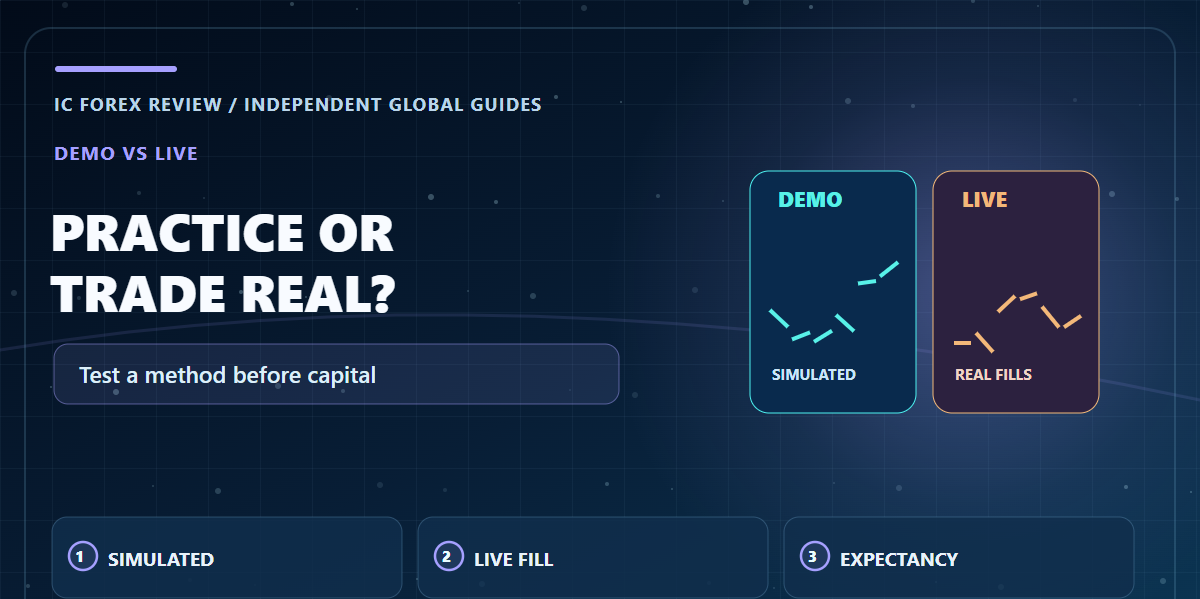
This guide explains how to get useful evidence from demo practice without mistaking it for guaranteed future performance. It focuses on the process a trader can test, the data that should be collected and the limits that remain when money is eventually at risk.
Demo and live: the core differences
| Aspect | Demo environment | Live account |
|---|---|---|
| Funds | Simulated balance | Actual money exposed to loss |
| Order handling | Training or simulation environment | Broker execution subject to market liquidity and conditions |
| Psychology | No direct financial loss | Fear, hesitation and risk aversion can alter decisions |
| Account verification | May be possible before live approval on some platforms | Eligibility and KYC requirements apply |
| Trading costs | Useful as a training assumption, not definitive proof | Actual spreads, commissions, swap and slippage |
Demo pricing may resemble the intended account but does not guarantee that an order would be filled at the same price in a live market. Connection quality, liquidity and volatility can create differences. A realistic evaluation must explicitly account for that uncertainty.
When a demo account is particularly useful
First, use it to learn the trading terminal. Understand the distinction between market, limit and stop orders; where stop losses and take profits appear; and how position size affects margin. Experiment with closing only part of a position if that functionality is available. Practice checking commission and swap lines rather than relying on a visual chart alone.
Second, use demo to verify whether your indicator or Expert Advisor is technically compatible with the chosen platform. MQL4 scripts do not automatically run as MQL5 code, and cTrader automation has a different ecosystem. A demo test should confirm that the strategy does what you intended, including when orders are rejected or prices move quickly.
How to make demo testing more realistic
Choose a simulated account size that resembles the risk capital you would actually consider, not an enormous balance that hides oversized positions. Use the same instrument list, approximate trading hours and intended account pricing structure. Record spread, time, proposed stop, actual simulated entry, and subsequent outcome for each trade. If you change the rules, note when and why.
A strategy that produces a smooth hypothetical equity curve under zero slippage should be tested with worse execution assumptions. Widen the spread in a separate spreadsheet scenario, consider news releases and imagine an order that fills several pips away from the requested price. If these realistic adjustments erase the apparent edge, the strategy is fragile.
What a demo cannot tell you about real fills
Demo orders may not face exactly the same depth, queueing or market-impact effects that influence real execution. A stop-loss order can fill at a worse price during a gap; an aggressively priced limit order may not fill at all; and spreads can widen when liquidity is thin. A backtest or simulator cannot guarantee that a live order would have found a counterparty under the identical conditions.
Broker infrastructure and server location are relevant operational factors, but they do not remove price uncertainty. IC advertises low-latency infrastructure for some platforms, yet an automated method still needs conservative execution assumptions and failure handling.
The psychology gap between simulated and real money
When there is no financial consequence, it can be easy to follow a stop-loss rule perfectly or let a position run according to plan. With real money, the same trader may move the stop, cut winners early or increase position size after losses. That behavioural change is not a feature of the software, but it can overwhelm any small statistical advantage uncovered during practice.
A useful demo journal therefore includes process grades alongside results: Did you obey the planned risk limit? Did you avoid trading during an excluded news window? Did you follow the entry condition exactly? Repeated rule-breaking in demo is a warning sign that requires attention before live funding.
Choosing a platform and account type for demo
IC Global lists MetaTrader Standard and Raw Spread structures and cTrader Raw options. MetaTrader 4, MetaTrader 5 and cTrader have different menus, coding environments and account connections. The TradingView integration through IC is intended for a cTrader Raw connection, including demo access while a live application is pending according to the broker's public FAQ.
Test the platform you actually plan to use. Spending a month mastering MT4 is valuable, but it does not by itself prepare you to write MQL5 code or manage a cTrader copy strategy. Platform knowledge and trading-signal reliability are separate problems.
How long should a demo test run?
There is no universally correct number of days. The test needs enough trades and diverse conditions to reflect the intended strategy. A low-frequency daily setup may require substantially longer observation than a strategy that generates dozens of signals each week. The number of completed trades, variety of volatility regimes and stability of rule-following matter more than an arbitrary “30 days to become profitable” claim.
Do not repeatedly tune parameters until one short stretch of historical or demo data looks attractive. Such optimisation can produce overfitting. A separate unseen period or forward-testing window offers a more meaningful check of whether the method survives changes in market behaviour.
Transitioning to live: a cautious checklist
- Confirm the legal entity and account rules relevant to your location.
- Document your strategy, invalidation point and maximum acceptable loss.
- Record performance after assumed realistic spread, commission and execution costs.
- Practice platform recovery from disconnections and rejected orders.
- Set clear limits for daily losses and total open exposure.
- Use money you can afford to lose and avoid jumping immediately to maximum leverage.
Even after those checks, real-money results may differ from demo. If the first live trades behave unexpectedly, pause and investigate rather than assuming a losing streak must reverse quickly.
Frequently misunderstood demo-account claims
“My demo made 30%, so live will too” ignores execution and behavioural differences. “Demo trades are fake, so nothing can be learned” misses the value of platform practice and rule testing. “A better broker guarantees my system will work” confuses execution conditions with the strategy's edge. A balanced view recognises that demo is necessary for many workflows but never sufficient proof of profitability.
Sources and disclosure
Official materials: IC account overview, TradingView demo and integration FAQ, and the broker Help Centre. For the broader broker review, see IC Markets (IC) Review 2026 and read our Risk Disclosure before considering real-money trades.
IC Forex Review is independent and may receive a commission from qualifying use of an IC partner link. No demo result or article here is investment advice or a guarantee of live trading performance.

Comments
Post a Comment