“Spreads from 0.0 pips” is a pricing headline, not a complete trade-cost calculation. When a position is opened and later closed, the trader may pay a spread, a separate commission, overnight financing, currency conversion and execution slippage. Depending on the strategy, some of those charges can matter more than the number shown in a broker advertisement.
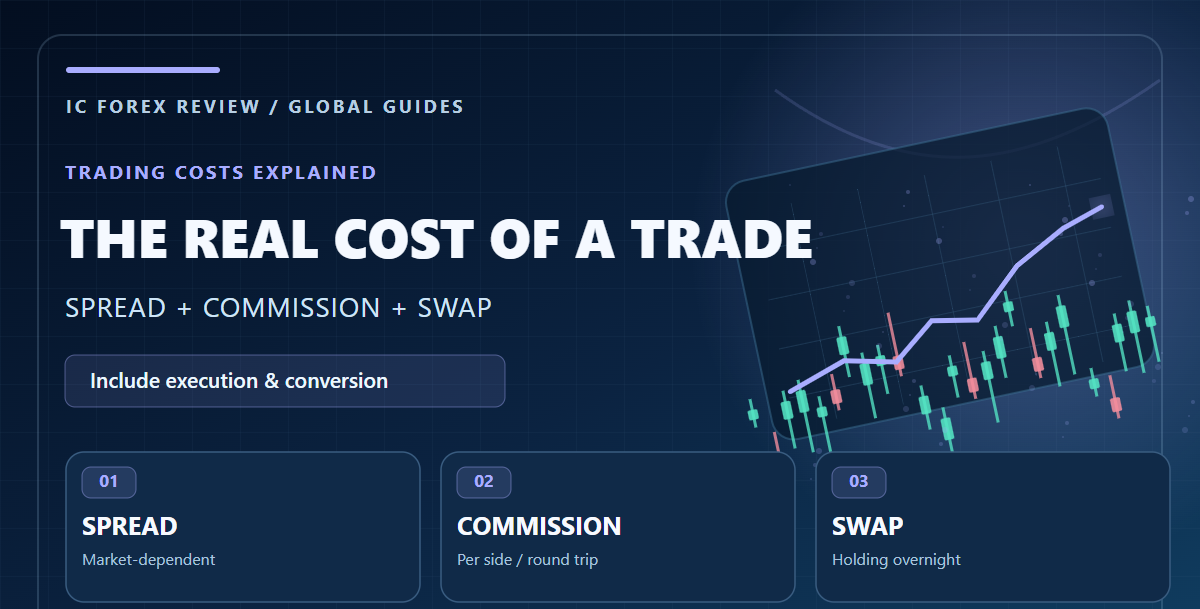
This guide explains how to estimate the all-in cost of trading forex at IC, formerly IC Markets, without pretending that an illustrative price is a live quote. We checked IC's published Global account and pricing information on 14 October 2026. Legal entities and symbol specifications may differ, so always confirm the figures available on your own account.
One formula for a completed trading round trip
For a simple forex position, a helpful approximation is:
Total trading cost ≈ (spread in pips × pip value) + round-trip commission + overnight financing + execution and currency-conversion effects.
That formula is a starting point, not a universal accounting rule. A position filled in several pieces, a pair quoted in another currency or an exotic CFD with a different contract specification can require a more detailed calculation. The actual account statement is the correct record of what was charged.
What IC publishes for Standard and Raw Spread accounts
| Core Global account | Published forex spread from | Published separate commission |
|---|---|---|
| Standard MetaTrader | 0.8 pip | No separate forex commission |
| Raw Spread MetaTrader | 0.0 pips | USD 3.50 per standard lot per side |
| Raw Spread cTrader | 0.0 pips | USD 3 per USD 100,000 traded per side |
The first number in the spread column is a minimum advertised level. It does not state the spread most traders pay at the London open, just before a US data release or during the daily rollover. IC publishes typical-spread information but also notes that instrument specifications are subject to change and that the trading platform displays current details.
A worked EUR/USD example for one standard lot
Suppose a trader opens and closes one standard lot of EUR/USD in a USD-denominated account. A standard lot represents 100,000 euros and a pip is approximately USD 10 for this pair. To keep the calculation transparent, assume the Standard spread available at execution is 1.1 pips and the Raw Spread is 0.2 pip. These are imaginary examples, not measured broker spreads.
| Item | Standard | Raw MetaTrader |
|---|---|---|
| Assumed spread | 1.1 pips | 0.2 pip |
| Spread cost (USD 10/pip) | USD 11.00 | USD 2.00 |
| Commission for entry and exit | USD 0.00 separately | USD 7.00 |
| Total before swap and slippage | USD 11.00 | USD 9.00 |
Raw appears USD 2 cheaper in that scenario. If the actual Raw spread widened to 0.6 pip, its cost would increase to approximately USD 13 including commission, overtaking the hypothetical Standard example. A meaningful backtest of trading costs therefore needs assumptions that reflect the time of execution, not a permanent minimum.
Pip value, trade size and account currency
For a USD account trading EUR/USD, the same calculation scales to roughly USD 1 per pip for 0.10 lot and USD 0.10 per pip for 0.01 lot. This shortcut does not automatically carry over to USD/JPY, GBP/JPY or an account denominated in euros or Australian dollars. Calculate the value of one pip in the account currency using the quote currency and relevant conversion rate.
For CFDs on gold or indices, the term “pip” can be especially misleading because tick size, point value and contract multiplier follow a different specification. An XAUUSD trader should verify how many ounces a lot represents and how the platform defines a tick before applying any currency-pair formula.
Why spread widens when the market moves
Bid and ask quotes respond to liquidity, volatility, trading hours and price uncertainty. They may widen around scheduled news, weekend reopening or low-liquidity rollover periods. An order placed when the displayed spread is low may still experience slippage, partial fills or delays if the executable price changes before the order reaches the market.
Spread and slippage measure different things. Spread is the difference between the quoted buying and selling prices. Slippage is the difference between the expected execution price and the executed price. A trader who measures only the spread may underestimate the true cost of entering through a breakout or closing after a fast gap.
Swap and overnight financing
Positions held past the applicable rollover can incur financing debits or credits based on the account terms, instrument, trade direction and day. Some instruments have special or multiple-day adjustments around particular settlement dates. A multi-day strategy should include realistic financing assumptions, while a day-trading strategy that exits before rollover may have a different cost profile.
Swap-free account labels require just as much care: eligibility, grace periods and possible holding fees may apply, and those conditions may change by entity. Never assume that “swap-free” means every overnight cost is permanently zero.
What to record in your own cost journal
Record the symbol, lot size, account currency, execution timestamp, observed spread at entry, entry and exit fills, total commission, financing, conversion and any outside bank fees associated with moving funds. Compare trades under similar conditions instead of mixing quiet Asian-session quotes with volatile news periods. Over time, this provides an evidence-based estimate of whether a pricing structure genuinely suits your strategy.
Putting cost control ahead of profit promises
Paying less to execute is useful, but it does not turn a losing strategy into a winning one by itself. The risk per trade, distance to stop loss, leverage and behaviour during volatility remain central. If a strategy depends on a tiny profit target, even a modest increase in spread or slippage can change its expectancy.
For the differences between the full broker offering and its legal entities, read our IC Markets review for 2026. The homepage comparison also introduces the basic pricing models.
Source notes and affiliate disclosure
Figures checked on 14 October 2026 against the official account overview, spreads and commissions, and trading conditions. Any sample spread in this article is hypothetical.
This is an independent educational website. We may receive a commission from qualifying activity through our IC partner link. Check the actual entity, account terms and financial risks before taking action. No strategy or cost comparison guarantees trading profits.
Comments
Post a Comment